
 EN
EN  English
 Français
 中文简体
中文简体


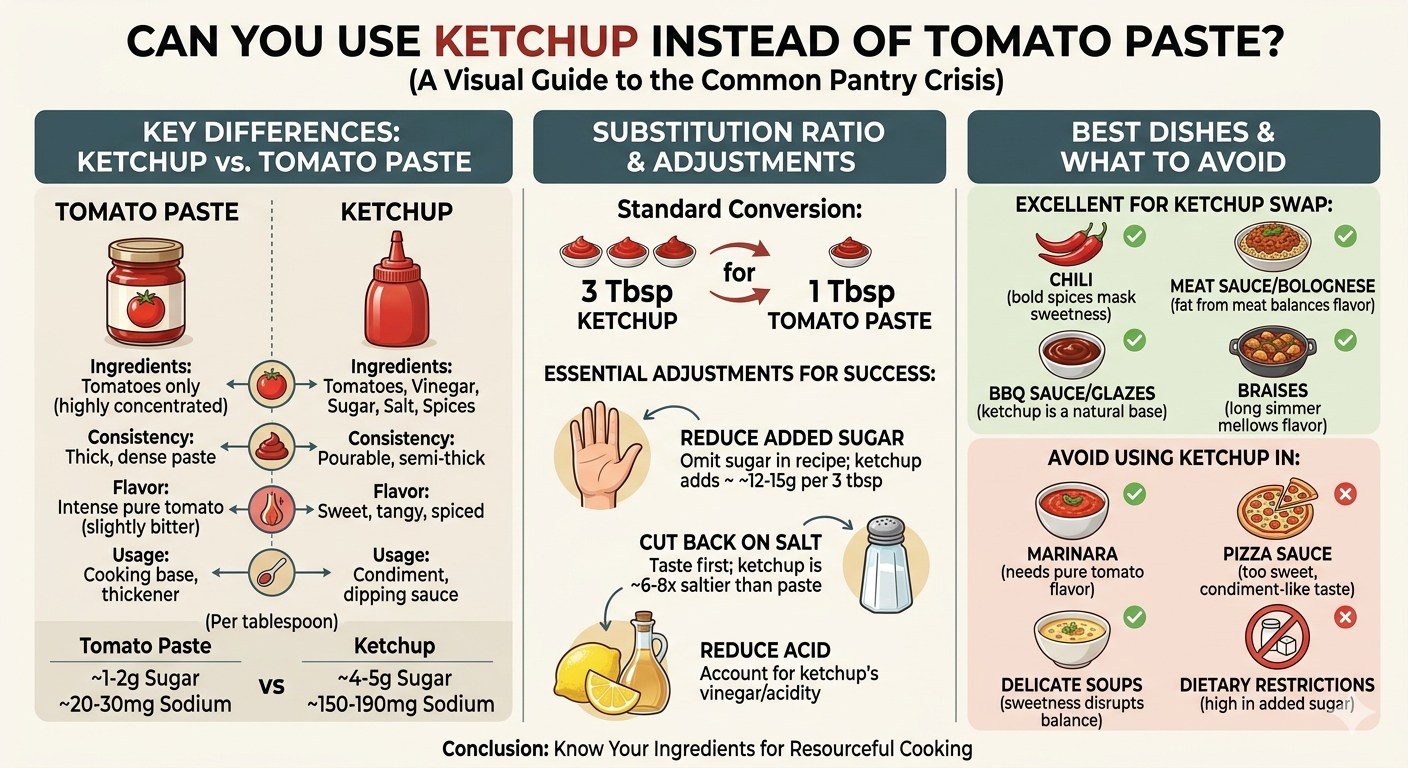
Yes — you can use ketchup instead of tomato paste in a pinch, but it will change the flavor, sweetness, and consistency of your dish. Understanding the key differences helps you adjust your recipe and get the best possible result.
Running out of tomato paste mid-recipe is a common kitchen crisis. You scan your pantry and spot a bottle of ketchup — the question immediately becomes: can it do the job? The short answer is yes, with caveats. Ketchup as a tomato paste substitute is workable in many savory dishes, but it is not a drop-in replacement. The two condiments are made from tomatoes, but they are fundamentally different products with different flavor profiles, sugar content, and concentrations.
This guide walks you through exactly when and how to use ketchup instead of tomato paste, the right conversion ratio, what adjustments to make, which dishes tolerate the swap best, and which ones do not — so you can cook with confidence even without your pantry staples on hand.
Content
- Ketchup vs. Tomato Paste: What Are the Key Differences?
- How Much Ketchup Equals Tomato Paste? The Right Conversion Ratio
- Which Dishes Work Well with Ketchup Instead of Tomato Paste?
- When Should You NOT Use Ketchup Instead of Tomato Paste?
- Ketchup as Tomato Paste Substitute: Dish-by-Dish Suitability
- How to Make the Ketchup Substitution Work: Step-by-Step Tips
- Nutritional Impact of Substituting Ketchup for Tomato Paste
- Other Substitutes for Tomato Paste Beyond Ketchup
- Frequently Asked Questions
- Conclusion: Ketchup Works — If You Know What to Adjust
Ketchup vs. Tomato Paste: What Are the Key Differences?
Ketchup and tomato paste are both tomato-based, but they are made for completely different purposes — and their ingredient lists reflect that. Before substituting one for the other, it helps to understand exactly what you are working with.
Tomato paste is essentially a highly concentrated form of cooked tomatoes. Tomatoes are simmered for hours and then strained to remove seeds and skins, leaving behind an intensely flavored, thick, deep-red paste. It contains very little else — most commercial tomato pastes list tomatoes as the only ingredient. Its job in cooking is to add concentrated tomato flavor and body to sauces, stews, and braises.
Ketchup, by contrast, is a fully seasoned condiment. It contains tomato concentrate, vinegar, sugar, salt, and spices such as onion powder, cloves, and cinnamon. It is thinner and much sweeter than tomato paste, and its acidic, tangy finish is by design — ketchup is a table sauce meant to be eaten as-is, not as a cooking base.
| Property | Tomato Paste | Ketchup |
| Main Ingredients | Tomatoes only | Tomatoes, vinegar, sugar, spices, salt |
| Consistency | Very thick, dense | Pourable, semi-thick |
| Flavor Profile | Pure, intense tomato — slightly bitter | Sweet, tangy, spiced |
| Sugar per tbsp | ~1–2g | ~4–5g |
| Sodium per tbsp | ~20–30mg | ~150–190mg |
| Tomato Concentration | Very high (~3x reduced) | Moderate |
| Primary Use | Cooking base, sauces, stews | Condiment, dipping sauce, glaze |
Table 1: A side-by-side comparison of tomato paste and ketchup across key nutritional and culinary properties.
How Much Ketchup Equals Tomato Paste? The Right Conversion Ratio
The standard substitution ratio is 3 tablespoons of ketchup for every 1 tablespoon of tomato paste — but this comes with important adjustments because ketchup is less concentrated, sweeter, and more acidic.
Here is why the ratio is not 1:1: tomato paste is far more concentrated than ketchup. A single tablespoon of tomato paste delivers roughly three times the tomato flavor of the same amount of ketchup. To compensate, you need more ketchup — but using three times the volume also means introducing significantly more sugar, vinegar, and salt into your dish.
To manage the flavor impact, make these adjustments when using ketchup in place of tomato paste:
- Reduce or eliminate added sugar — ketchup already contains 4–5g of sugar per tablespoon, so any sugar called for in your sauce recipe should be reduced or removed entirely
- Cut back on added salt — ketchup contains roughly 6–8 times more sodium per tablespoon than tomato paste; taste and season carefully
- Reduce other acidic ingredients — if your recipe calls for vinegar or lemon juice, reduce the quantity to account for ketchup's own acidity
- Simmer longer if possible — cooking ketchup into your dish for a few extra minutes mellows its sweetness and vinegar sharpness, bringing it closer to the deeper flavor of cooked tomato paste
| Tomato Paste Required | Ketchup to Use | Reduce Sugar By | Reduce Added Salt By |
| 1 tbsp | 3 tbsp | Omit any added sugar | Reduce by ~¼ tsp |
| 2 tbsp | 6 tbsp (⅜ cup) | Omit or cut by half | Reduce by ~½ tsp |
| ¼ cup (4 tbsp) | ¾ cup | Cut recipe sugar by 75%+ | Reduce by ~1 tsp |
Table 2: Ketchup-to-tomato paste substitution ratios with recommended seasoning adjustments.
Which Dishes Work Well with Ketchup Instead of Tomato Paste?
Ketchup works best as a tomato paste substitute in robustly flavored, well-seasoned dishes where the sweetness and acidity can be absorbed or balanced by other ingredients.
1. Meat Sauces and Bolognese
Ketchup blends surprisingly well into meat-based sauces. The fat from ground beef or pork, combined with aromatics like garlic and onion, effectively dampens ketchup's sweetness. A bolognese or chili-style meat sauce cooked low and slow for 30–45 minutes will absorb ketchup's flavors smoothly. Use the 3:1 ratio and skip any added sugar in the recipe.
2. Chili
Chili is one of the most forgiving dishes for this swap. The combination of spices — cumin, chili powder, smoked paprika — and the long simmering time means ketchup's sweetness becomes a gentle background note rather than a dominant flavor. Many home cooks actually prefer their chili with a slightly sweet tomato base. Use about ½ cup of ketchup in place of 3 tablespoons of tomato paste and reduce any added sugar or molasses in the recipe.
3. Braised Short Ribs and Pot Roasts
Braises that cook for two or more hours in liquid are excellent candidates. The long cooking time allows ketchup's vinegar and sugar to mellow and integrate into the braising liquid, adding a rounded tomato depth to the sauce. Reduce other acidic components like red wine or Worcestershire sauce slightly.
4. BBQ Sauces and Glazes
This is arguably where ketchup as a tomato paste substitute works best of all — because ketchup is already a core ingredient in most homemade BBQ sauce recipes. Replacing tomato paste with ketchup in a BBQ glaze or marinade context is entirely natural and often produces a sweeter, more balanced result with minimal adjustment needed.
5. Shakshuka and Egg Dishes
Shakshuka — eggs poached in a spiced tomato sauce — can accommodate ketchup reasonably well, especially when the sauce includes robust spices like cumin, harissa, or smoked paprika. The spices mask ketchup's sweetness effectively. Use less added sugar and increase the spice quantities slightly to compensate.
When Should You NOT Use Ketchup Instead of Tomato Paste?
Avoid substituting ketchup for tomato paste in delicate, subtly flavored dishes where the sweetness and vinegar will be clearly detectable and out of place.
- Classic Italian tomato sauces (marinara, pomodoro): These sauces rely on the pure, clean flavor of tomatoes. Ketchup's vinegar and sweetness will make a marinara taste noticeably different — and not in a way that honors the dish.
- Pizza sauce: Pizza sauce is built on concentrated tomato flavor seasoned with oregano and garlic. Ketchup will make it taste too sweet and condiment-like, which will be obvious in every bite.
- French onion soup and consommé: Dishes where tomato paste is used in very small quantities to add color and umami depth — rather than flavor volume — will be thrown off by ketchup's sweetness even in small amounts.
- Soufflés and baked egg dishes with delicate seasoning: Any recipe where balance and subtlety are critical will be compromised.
- Recipes for people with dietary restrictions: Ketchup's high sugar content makes it unsuitable for low-sugar or diabetic-friendly recipes that call for tomato paste.
Ketchup as Tomato Paste Substitute: Dish-by-Dish Suitability
The table below summarizes how well ketchup works as a tomato paste replacement across common recipes, giving you a quick reference for your kitchen decisions.
| Dish | Suitability | Key Adjustment Needed |
| Chili | Excellent | Omit added sugar; boost spices |
| Meat sauce / Bolognese | Good | Simmer longer; reduce salt |
| BBQ sauce / glaze | Excellent | Minimal adjustment needed |
| Beef stew / braise | Good | Reduce wine/vinegar; less salt |
| Shakshuka | Acceptable | Increase spices; omit sugar |
| Marinara / tomato sauce | Not recommended | Flavor will be noticeably off |
| Pizza sauce | Not recommended | Too sweet; condiment-like taste |
| French onion soup | Avoid | Sweetness disrupts delicate balance |
| Low-sugar / diabetic recipes | Avoid | Ketchup is high in added sugar |
Table 3: Suitability ratings for using ketchup as a tomato paste substitute across common dishes, with key adjustments.
How to Make the Ketchup Substitution Work: Step-by-Step Tips
Following a few practical steps when using ketchup instead of tomato paste will significantly improve the result.
- Step 1 — Measure carefully: Use exactly 3 tablespoons of ketchup for every 1 tablespoon of tomato paste the recipe requires. Do not eyeball it — the ratio matters.
- Step 2 — Taste before adding other seasonings: Add the ketchup first, stir it in, and taste the dish before adding any salt, sugar, or acid called for in the recipe. This tells you exactly how much adjustment is needed.
- Step 3 — Cook it in: Always add ketchup early enough that it can cook into the dish rather than sitting on top of it. Sauté it briefly in oil with your aromatics for 2–3 minutes before adding liquids — this caramelizes some of its sugars and drives off some of the vinegar sharpness.
- Step 4 — Balance with umami: If the dish feels too sweet or too bright after using ketchup, add a small amount of soy sauce, Worcestershire sauce, or a pinch of fish sauce to restore savory depth. These are natural umami boosters that counterbalance sweetness.
- Step 5 — Adjust liquid content: Because ketchup is thinner than tomato paste, it introduces extra moisture. If your dish relies on tomato paste for thickening, you may need to simmer a few extra minutes to reach the desired consistency.
Nutritional Impact of Substituting Ketchup for Tomato Paste
Switching from tomato paste to ketchup adds meaningful amounts of sugar and sodium to your dish — a consideration that matters for health-conscious cooking.
Using 3 tablespoons of ketchup (to replace 1 tablespoon of tomato paste) introduces approximately:
- 12–15g of added sugar — roughly 3 teaspoons, or about 50–60% of the American Heart Association's recommended daily added sugar limit for women
- 450–570mg of sodium — around 20% of the recommended 2,300mg daily maximum
- Marginal increases in vinegar-based acids, which affect taste more than nutrition
For a single substitution in a family-sized batch of sauce these amounts are diluted across multiple servings, making the per-person impact moderate. But for health-conscious cooks or anyone managing blood pressure or blood sugar, the substitution is worth flagging — and adjusting recipe sugar and salt accordingly is essential.
Other Substitutes for Tomato Paste Beyond Ketchup
If ketchup is not ideal for your recipe, several other pantry options can substitute for tomato paste more faithfully.
| Substitute | Ratio | Flavor Match | Best For |
| Tomato sauce (canned) | 3 tbsp per 1 tbsp paste | Very good | Pasta sauces, soups |
| Crushed tomatoes (reduced) | Reduce ¼ cup to ~1 tbsp | Excellent | All-purpose; best flavor match |
| Sun-dried tomatoes (blended) | 2 tbsp blended per 1 tbsp paste | Good (more complex) | Braises, Mediterranean dishes |
| Ketchup | 3 tbsp per 1 tbsp paste | Fair (sweeter, tangier) | Chili, meat sauces, BBQ |
| Fresh tomatoes (cooked down) | 2–3 medium tomatoes per 2 tbsp | Good (watery at first) | Slow-cooked dishes |
Table 4: Alternative tomato paste substitutes compared by substitution ratio, flavor match, and best use cases.
If you have canned crushed tomatoes or tomato sauce on hand, either of those will produce a more faithful result than ketchup in most recipes. Reserve the ketchup substitution for dishes where its sweetness and tang can be an asset or at least easily managed.
Frequently Asked Questions
Q: Can I use ketchup instead of tomato paste in pasta sauce?
It depends on the type of pasta sauce. For a meat-based pasta sauce like Bolognese, ketchup can work with adjustments — reduce sugar and salt, and simmer well. For a classic marinara or pomodoro, ketchup is not a good substitute because the clean tomato flavor is the centerpiece of the dish and ketchup's sweetness and vinegar will be clearly detectable.
Q: How do I reduce the sweetness if I used too much ketchup?
If your dish tastes too sweet from ketchup, add a small pinch of salt, a splash of unseasoned vinegar, or a squeeze of lemon juice to counterbalance the sweetness. A pinch of smoked paprika or an additional savory ingredient like soy sauce or Worcestershire can also help restore balance without adding more sweetness.
Q: Is ketchup the same as tomato paste?
No — ketchup and tomato paste are fundamentally different products. Tomato paste is a concentrated, unseasoned cooking ingredient made purely from cooked, strained tomatoes. Ketchup is a seasoned condiment containing vinegar, sugar, salt, and spices. They share tomato as a base but serve entirely different culinary functions.
Q: Can I use ketchup in chili instead of tomato paste?
Yes — chili is one of the best dishes for the ketchup substitution. The bold spices in chili (cumin, chili powder, paprika) mask ketchup's sweetness effectively, and the long simmer time blends the flavors well. Use about ½ cup of ketchup in place of 3 tablespoons of tomato paste and skip any added sugar the recipe calls for.
Q: Does cooking ketchup change its flavor?
Yes, significantly. When ketchup is cooked, especially sautéed or simmered for 10 or more minutes, it loses some of its sharp vinegar taste and caramelizes slightly, developing a richer, deeper tomato flavor. Always cook ketchup into your dish early and allow time for it to mellow before tasting and adjusting seasoning.
Q: What is the best substitute for tomato paste if I don't have ketchup either?
The best alternative is canned tomato sauce or crushed tomatoes reduced on the stovetop. Simmer ¼ cup of crushed tomatoes in a small pan over medium heat for 10–15 minutes until it reduces to about 1 tablespoon. This creates a close approximation of tomato paste with a pure, clean tomato flavor and no added sugar or vinegar.
Conclusion: Ketchup Works — If You Know What to Adjust
Using ketchup instead of tomato paste is a legitimate kitchen workaround — not a perfect replacement, but a practical one that can save a meal when you are out of options. The key is understanding the differences: ketchup is sweeter, thinner, saltier, and more acidic. Apply the 3:1 ratio, reduce other sugars and salt, cook it in early, and choose the right dishes.
Dishes like chili, meat sauces, braises, and BBQ applications are excellent candidates. Classic Italian tomato sauces, pizza sauce, and delicate soups are not. When even better options are available — tomato sauce, crushed tomatoes, or sun-dried tomatoes — use them. But when ketchup is all you have, now you know exactly how to make it work.
The best cooks are resourceful ones. Understanding your ingredients and how to substitute wisely is a skill that turns pantry limitations into opportunities — and a splash of ketchup, handled correctly, can absolutely rise to the occasion.
 No.1 Tongqianqiao Road, Dongpu Village, Simen Town, Yuyao, Zhejiang Province
  nbms@nbtomato.com
